In the field of medical diagnostics, understanding what factors affect diagnostic test accuracy is crucial. Dr. Emily Carter, a leading expert in diagnostic medicine, emphasizes, "Test accuracy is influenced by many variables, including the patient population and test methodology." This highlights the complexity of diagnostic processes.
Many factors play a role in determining test accuracy. These include the characteristics of the test itself, the timing of the test, and the population being screened. For instance, a test’s sensitivity and specificity are critical metrics that can greatly impact outcomes. Additionally, operator skill adds another layer of complexity. Mistakes can lead to missed diagnoses or false positives.
It is essential to reflect on these influences when evaluating diagnostic tests. Recognizing that no test is infallible encourages ongoing research and improvement. The question remains—how can we better understand and mitigate these factors? Ultimately, a deeper comprehension of what factors affect diagnostic test accuracy will improve patient care and outcomes.
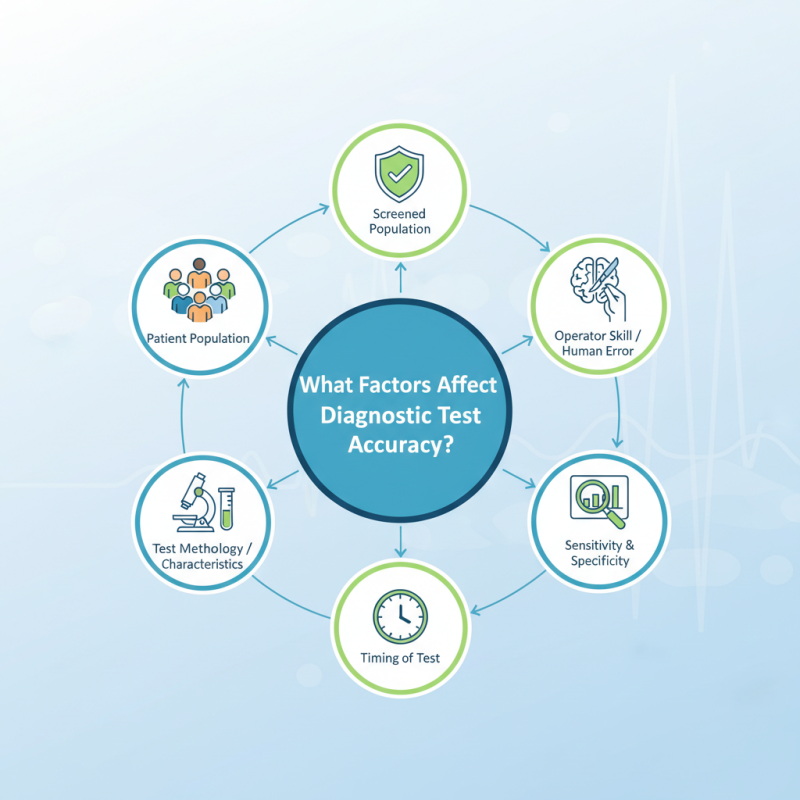
Designing effective diagnostic tests involves understanding various influencing factors. One key aspect is the target population's characteristics. For instance, age, gender, and ethnicity can significantly affect test results. A study published in the Journal of Clinical Epidemiology highlights that accuracy can vary by as much as 30% across different demographics. Recognizing these variations is essential for tailoring diagnostic approaches.
Another crucial factor is the test methodology itself. Choice of technology, sample types, and detection thresholds can all influence accuracy. A meta-analysis in the British Medical Journal found that tests using higher sensitivity often had reduced specificity. This trade-off introduces complexity in interpreting results. Health professionals must balance these elements to ensure reliable outcomes.
Finally, the context in which a diagnostic test is implemented matters greatly. Testing conditions, such as the operator's proficiency and laboratory settings, can impact results. Reports indicate that human errors contribute to approximately 10-15% of inaccurate diagnoses. Acknowledging these potential pitfalls can guide improvements in test design and implementation strategies.
Sample size plays a crucial role in determining the accuracy and reliability of diagnostic tests. A larger sample size generally leads to more precise results. When tests have ample data, they can better capture the variations in the population. This ensures that the test reflects true performance across diverse groups. However, many researchers use smaller samples, which may skew results and reduce reliability.
Consider this: A small sample might overlook outliers or rare cases. This can create a false sense of security about a test's effectiveness. For instance, if a diagnostic tool designed to identify a specific condition is evaluated with only a handful of cases, it risks producing misleading accuracy rates. Therefore, a balanced approach is vital, prioritizing representative samples.
Tips for improving sample size considerations include consulting with biostatisticians early in your study. They can provide insights on the necessary size for statistical significance. Additionally, exploring demographic diversity in sample selection enhances the reliability of the results. Reflecting on the challenges of small samples can lead to greater awareness of study limitations, fostering more robust research designs in the future.
Diagnostic test accuracy is significantly influenced by the prevalence of the disease being tested. When a disease is rare, it can lead to fewer positive results. This means that even a highly accurate test might produce more false positives than true positives. The low prevalence skews results and hampers the test's overall effectiveness. For instance, a test with 95% accuracy could yield misleading statistics in a population where the disease prevalence is only 1%.
Conversely, in a high-prevalence setting, the likelihood of true positives increases. A test might yield different results based on the population being assessed. Medical practitioners must interpret test outcomes in context. It's important to consider disease prevalence along with the test's sensitivity and specificity. Without this understanding, there’s a risk in making clinical decisions based solely on test results. This complexity highlights the inherent challenges in diagnostic medicine. It's crucial for healthcare professionals to communicate these nuances to patients and consider them when forming treatment plans.
Diagnostic test accuracy plays a crucial role in healthcare. Key metrics include sensitivity and specificity. Sensitivity measures a test's ability to identify true positives. For example, if a test has 90% sensitivity and 100 individuals have a condition, 90 will test positive. However, this does not account for false negatives. A high sensitivity is essential, particularly for serious illnesses.
Specificity, on the other hand, evaluates a test's ability to correctly identify true negatives. It indicates how well a test can rule out those without the condition. A test with 85% specificity will miss 15 out of 100 healthy individuals, leading to unnecessary anxiety or further testing. Balancing sensitivity and specificity is challenging. A test optimized for one may compromise the other.
Healthcare professionals often face dilemmas when interpreting these metrics. A test with high sensitivity might yield many false positives, while one with high specificity may miss critical cases. Understanding these nuances helps in making informed decisions. This knowledge empowers clinicians to choose the most appropriate tests for their patients.
Technological advancements have significantly transformed the landscape of diagnostic testing. New technologies, such as artificial intelligence and advanced imaging techniques, enhance accuracy. These innovations allow for earlier disease detection. For example, AI algorithms analyze patterns in data, improving how tests identify conditions. This integration provides more reliable results. Quality control in the development phase is crucial for maintaining accuracy.
Tips: Always stay updated with the latest trends in medical technology. Understanding these advancements can help appreciate their impact on diagnostics.
However, not all new technologies ensure improved accuracy. Rapid adoption can lead to discrepancies in results. Healthcare professionals must thoroughly evaluate new tools. Rushed implementations without proper training may hinder their effectiveness. Continuous learning and adaptation are essential for success in this evolving field.
Tips: Collaborate with experts in the field to assess the validity of new testing methods. Peer reviews can provide useful insights.
Understanding the balance between innovation and reliability is key. Emerging technologies bring potential, but they require careful consideration. Focusing solely on technological advancements can obscure other important factors affecting accuracy. Effective diagnostics rely on multiple dimensions working together harmoniously.
: Sample size impacts the accuracy and reliability of test results. Larger samples provide more precise outcomes.
Small samples may miss outliers or rare cases, leading to misleading accuracy rates and lower reliability.
Rare diseases can produce more false positives, even if a test is highly accurate. This skews results.
Consulting biostatisticians early in the research process is essential for determining appropriate sample sizes.
Test outcomes vary based on disease prevalence. High prevalence increases the likelihood of true positives.
Relying solely on test outcomes without considering context can lead to flawed clinical decisions.
Diverse samples enhance reliability and reflect true performance across different groups.
Recognizing small sample limitations encourages better research designs and awareness of study weaknesses.
It's vital to explain the nuances of test outcomes and the significance of disease prevalence to patients.
Interpreting tests involves understanding prevalence, sensitivity, and specificity, making it a challenging field.
The accuracy of diagnostic tests is influenced by several key factors that healthcare professionals must understand. Among these, the design of the test plays a crucial role, as it determines how effectively the test can detect a disease. Additionally, the sample size used in testing significantly impacts accuracy and reliability; a larger sample often results in more dependable outcomes.
The prevalence of a disease within a population also affects diagnostic test outcomes, as higher prevalence may lead to better test performance. Understanding sensitivity and specificity is essential for evaluating how well a test performs in identifying true positive and true negative cases. Finally, advancements in technology continuously enhance diagnostic accuracy, enabling more precise tests. Overall, recognizing what factors affect diagnostic test accuracy is vital for improving healthcare outcomes and ensuring effective disease management.

Medvok Medical